
Talking to Ourselves
Don't Believe Everything You Think

Talking to Ourselves has been reprinted many times since I first wrote it in the mid 1990s. Loompanics published it first, then The Thought and Groundswell: An Anti-Authoritarian Journal. Enemy Combatant Publications included it in their Crimes of Perception anthology, and Imediatism.com posted an audio reading of the essay in 2019. This new Substack version has been updated and edited from the original.
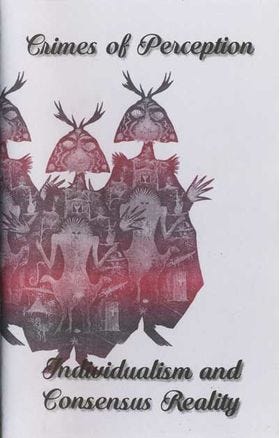
Pic: Cover of Enemy Combatant Publications’ “Crimes of Perception”
"I encounter language as a facility external to myself and it is coercive in its effect on me. Language forces me into its patterns." -- Peter L. Berger and Thomas Luckmann in The Social Construction of Reality
“A person who thinks all the time has nothing to think about except thoughts. So, he loses touch with reality, and lives in a world of illusions. By thoughts, I mean specifically, chatter in the skull. Perpetual and compulsive repetition of words, of reckoning and calculating.” — Alan Watts, Stop Overthinking
Voices in our heads: are they the echoes of our thoughts? Are they the gift of inspiration from a personal muse or god? Or are they the neurological chatter between two hemispheres of a brain that has been traumatized by the pressures of a human population on the verge of maximizing ecological collapse and self-destruction?
Each of us experiences, almost constantly, one form or other of verbally induced hallucination. Yes, I mean that literally. It may be manifested as a song that we can't get out of our head, or as a remembered argument that we keep replaying on a tide of adrenaline, subtly changing the script each time and inserting the witticisms we wish had come to mind, until we are satisfied with the versions we choose to commit to memory. The ever-present voice of thought may be experienced as the words of a fervent prayer, or as the sound of our own name that makes our heads turn, only to find that no one has called to us, and we have constructed the experience from the garbled bits of auditory information that fill a crowded room.
So simple a thing as thinking or remembering will conjure voices inside of us. Usually, we take them for granted, believing them to be a natural and indivisible part of us. It is only when our attention is forcibly focused on these voices that we begin to feel queasy and self-conscious that the inner-most company we keep has been exposed to scrutiny. Our thoughts, ruminations, dreams and fantasies are personal and private. We don't like being held publicly accountable for them.
Popular wisdom has it that the first sign of mental distress occurs when you start talking to yourself. If that's the case, we are all in deep trouble. Whether vocalized audibly or not, verbal communication with the self is a commonplace phenomenon. Even when we are not talking to somebody else, we continually talk to ourselves. Prelingual verbalizations, in which we short-circuit the actual speaking of words yet subjectively experience serial vocalizations, comprise what most of us mean when we say we are thinking. We tend to do this thinking using the phonetic representations of words that are available in the symbolic coinage of a language generated by a culture.
Subjectively, there seems to be something valuable and precious about this practice of thinking. Thinking, we are told, validates our very existence. René Descartes is credited with dismantling philosophical inquiries prior to his lifetime and replacing what came to be considered metaphysical babble with the simple profundity: “I think, therefore I am.” By accepting this opinion of our subjective ruminations, giving them existential eminence, subsequent generations of thinkers have reconceptualized our ability to experience our own existence and survival as entities as inextricably dependent upon the pre-laryngeal manipulation of verbal symbols. This change-of-mind, which really amounts to a revolution in human consciousness, has mesmerized the Western world into the deification of subjectivity by attributing godlike powers and taxonomic superiority to humanity's most intimate confidant: his own brain.
According to Julian Jaynes’ controversial bicameral mind theory, this mental revolution is not a departure from our evolution as big-brained primates. It is a new expression of a primitive mindset that the earliest of human writings unabashedly reveal in which gods talked directly to humans. At least, that is how our ancestors experienced what today we call thought, before the symbolic representations of codified language were created. Ancient literature is replete with straight-forward accounts of deities slipping into the headspace of legendary characters. But we are mistaken in believing we have escaped their naivete. Today’s modern sophisticate is less aware of the alien source of inner mental experiences. Sure, we suspect being manipulated by the new oracles of social media, political and commercial propaganda, and artificial intelligence, but we remain certain of our ego independence from all of it.
In accepting the existential opinion formalized by Descartes, we continue to omit any recognition of the cultural malleability of our mental musings. By internalizing the existential identity of thought, believing our thoughts to be our own and proof of the reality of our selves, we institutionalize our subjective perceptions as being true representations of WHAT IS. This has been the practical outcome and, in part, may account for the rise in the popular sense of individualism, as well as the ease with which a growing number of individuals question official pronouncements of what is true. But on closer inspection this seeming independence of mind can be shown to be rooted in loyalty to one of the many schools of thought, paradigms, or ideologies formulated by people who preceded us in time. These narratives are assemblages of words and their connotations, and they constitute the raw material of our thoughts.
That other minds in the past have and presently continue to perceive things much differently than we do does not seem to breach the certainty we espouse for our own opinions. When we are confronted by others who do not share our thoughts but espouse weird views that contradict them, we react as though those variant thoughts are frontal assaults not merely on our convictions, but also on our existence and survival. Heresy is, to us, as much a biological threat as an ideological one. It is a logical outcome of our trust in the reasoning of Descartes, and hence ourselves.
How devastating to the ego, to the sense of certainty and security, would be the notion that we are not identical with our own thoughts! Such would be the blasphemy against our fundamental belief and against the self-coronation of our deified individuality that we would seek to evade the concept at all costs, disprove it through emotional rationalizations, and finally deny that the subject had ever been broached. Any hint that the chatter going on between our ears might be inaccurate, ungenuine, or even delusional is met with hostility. Given our dogmatic linkage between what we think and what we are, our instinctual reaction is adrenal and defensive. Every ego flies the banner: 'Don't tread on my opinions,' and defends those opinions with everything from blissful ignorance to violence against non-identical opinions. It is as though our brains have developed an organic defense mechanism to reject transplantation of ideas.
We seem to have no difficulty asserting the invalidity of someone else's mental chatter. We are even willing to go so far as defining disagreeable thoughts in others as symptoms of perceptual malignancy, which we feel justified in treating with therapeutic incarceration or mandatory sedation, or a combination of social coercion and restraint. It seems not to occur to us that if one set of perceptions can be judged invalid, so may they all, including our own.
Another thing that does not seem to occur to us regularly is that our thoughts, the very ones we defend so vigorously, are not our own in large measure. They are bestowed on us, defined first in their form by the grammar and rules of expression. Secondly, our thoughts are defined (given finite bounds) by the limited variety of symbols in our language. In essence, we are too often left at a loss for words. The third and perhaps most hideous way that our thoughts are defined and formed by something other than ourselves is through social intervention into the individual psyche.
The mandatory admission of certain 'truths' and the strict adherence to certain taboos effectively box-in any longing for creative and individualized mentation. Fourthly, the conscious blurring of distinctions between what symbols we are left to reason with is a familiar rhetorical tool used by the influential in order to manipulate the thoughts we do manage to put together in our heads. A quick reference to George Orwell's appendix to his novel 1984 will be quite instructive.
Each 'healthy' individual, as defined by society's sycophants, acts as a resonator of socially acceptable thought. Mental health is recognized by the AMA and syndicated psychological columnists as the ability of the individual mind to vibrate sympathetically, like a tuning fork, to society's keynote speakers and authorities.
That the music of our cranial spheres does not emanate from the gods, nor leap heroically into existence out of our very being, is a disconcerting thought to some. If we are conditioned to think certain thoughts on cue, as was Pavlov's dog conditioned to the dinner bell, are we any better than trained dogs?
The authorities and experts don't want us to know it, but when we identify our true selves with the mental constructs into which we have been educated and conditioned, without being aware of the real source of those mental constructs, we sow the seeds of paradox and personal turmoil. Professional psychologists frustrate themselves trying to eradicate from popular consciousness the idea of a split personality as the hallmark of severe mental illness. For as much as they try to impress upon laymen that this is an erroneous popular understanding of psychological disorders, there is strong popular identification with the notion that the mind can be at odds with so-called sane society, and thus 'split.' What is at odds in such cases is the perceived self-interest of the patient and the attempted imposition of prefab perceptions by society. Psychosis may be the healthy reaction of a mind defending itself from forceful obliteration.
Are the thoughts we have the thoughts we are allowed to have? And if our thoughts are who we are, then are we merely who we are permitted to be? Have they, as Thomas Pynchon put it, in Gravity’s Rainbow "busted the sod prairies of our brains, tilled and sown them, and subsidized us not to grow anything of our own?"
The talking heads of television anchormen and YouTube pundits, as they interpret and critique for us the doings in the world out there, are but relay stations, transmitting the communal image to be subjectively experienced as the world 'in-here,' that is, in the talking heads we carry around on our shoulders The voices that are allowed to reverberate in our heads are catechetical and instructive as to permissible attitudes, perceptions, and behavior. Society is the brain's FCC, and it will take away our license to receive and transmit, if we break its rules. And no, we didn’t have to wait for the earthly arrival of Donald Trump for that to be the way it works.
Most of us are true believers of one stripe or another, believing in any dogma, any expert, any cause as manifestly more legitimate than our own unfiltered perceptions. We are conditioned to live the catechetical rather than the gnostic life. We can't hear ourselves think over the constant chatter of internalized injunctions and propaganda. We are all talk. Subtly, we have been taught that life is not a participatory sport.
Talking to ourselves, or thinking, according to the hypocritical defenders of the consensus, is one of the healthiest things we can do. It actively reinforces, through repetition, our verbal social conditioning. Reality-testing among suspect clients sets off alarms in the suspicious minds of society's watchdog mental health professionals, who don't know that the reality they inquisitorially defend against close scrutiny by the insane (unsanitary thinkers) is a mere consensus, not an absolute.
The more intrepid among us may prefer to challenge the consensus, despite the dangers of openly doing so. There is good evidence that once a mind becomes convinced that the greater portion of its thoughts and opinions have not been self-generated, but in fact comprise a cultural artifact imprinted upon the organ of perception, this knowledge is sufficient to begin a process of self-discovery. The Socratic dictum to 'know thyself' loses some of the tarnish of a cliché and takes on new life once there is a realization that thought is not necessarily self. Coincidentally, the discomfort of becoming self-conscious when one's private thoughts are put under the spotlight is not so much traumatic as it is revealing. In fact, I’d like to retool the way the term brainwashing is used. Opinions of society to the contrary notwithstanding, ridding the mind of culturally insinuated content mistaken for personally generated thought can indeed have a cleansing effect. Becoming conscious of one's true self as distinct from the shrapnel of words ricocheting blithely inside our heads would seem to be a liberating experience worth pursuing.